Open source developers ask
For the answer, look to other professions.
Architects, for example.
Think about it: how are architects assured of getting paid for their work? (After all, their drawings are like open source. Anyone could just go ahead and build from them.)
The answer is that the city won’t let a building be occupied until the architect agrees to it by signing for the issuance of the occupancy permit. So the architect must be paid before their work can be put to use.
That’s why successful architects have seven figure incomes.
Everyone benefits: the community knows that its buildings can be trusted to meet standards, and the architects get paid generously.
Wouldn’t it be nice if software development worked that way?
But of course there’s a catch. The architect must accept professional liability for their work. If it turns out that the building isn’t secure, the architect could lose their license to practice, and the generous income that comes with it.
Professional licensing is a core part of the new software assumptions.
Learn about the new software assumptions landscape:
… and about other professional licenses for digital professionals.

Architects, Doctors, Lawyers
Architects, Doctors, Lawyers, and other professions require licensing by public authority.
An architect’s professional license means accepting liability for their work.
And they wouldn’t have it any other way – because accepting liability means getting paid well.
Now, with the City of Osmio’s professional licensing, you’ll participate in the solution to all of the problems facing the world’s information infrastructure.
Three sets of assumptions
about
our digital world
Which set of assumptions fits your assumptions most closely?
1
I’m content with what Silibandia gives me.
(Silibandia = Silicon Valley plus the broadband and media industries plus their feeders in the data brokerage, dark web, botnet, private equity, venture capital and cybersecurity industries.)
2
I’m not content with what Silibandia gives me, and so I help build open source alternatives.
3
I’m not content with what Silibandia gives me, but the open source community often overlooks the need for accountability. I want real privacy for myself, and I want real accountability from others. I want Authenticity enabled open source.
If your choice is #1, thanks for your time, let’s not waste any more of it.
If you answered 2 or 3, let’s talk.
Here’s the new software assumptions landscape:
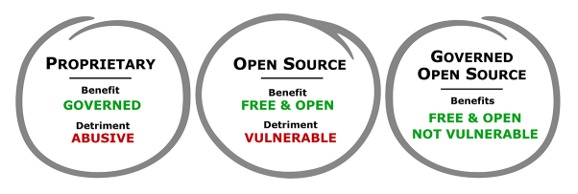
Until now, the world of software licensing has been divided into proprietary and open source models. That has served us well… or has served us anyway, for decades. But we’re going to show you that the world needs something better – a third way if you will. Allow us to introduce that third model to you.
But first, to quote a big software-driven company, this is not your usual yada yada.
This is genuinely new.
It’s about governance.
The proprietary ecosystems ...
…of Apple, Adobe, Microsoft, Oracle and others are governed. In each case, an identifiable entity, a company, takes responsibility for keeping the system useful and secure. That’s good.
Open source software ...
…also provides its own kind of goodness. Anyone can put open source software to use, avoiding market manipulation, proprietary barriers, license fees, file format gotchas, hidden privacy erosion techniques, and the rest of the not so good stuff that infests proprietary technology.
Proprietary software might have been OK when your phone was wired into the wall and your “micro” computer was an unconnected glorified typewriter. But now that we live a large portion of our lives in the digital world, that private, closed governance has us all living down on the plantations of the owners of those proprietary platforms.
So how do we get the benefits of both governed systems and open source systems at the same time?
The answer is:
Governed Open Source
Before we illustrate by taking closer look at that word governance, we need to deal with that old bugaboo, centralization. Specifically we’ll quote the noted advocate of decentralization, Lawrence Lundy-Bryan, who proclaims
“There is no such thing as decentralized governance.”
If you think about it, isn’t that self-evident? The things we use in our daily lives, including software, may work OK as disconnected widgets, but if governance is a do-your-own-thing matter, well, that’s simply not governance.
In the physical world, municipalities are effectively governed by activists – residents who get involved by showing up for hearings and paying attention to what goes on in city hall. The governance of cities is much more participatory than the governance of nations, with their many layers of representation and bureaucracy obfuscating the realities of government from the governed. It’s nations, not cities, that give centralized government its bad rap.
Now let’s see how that notion applies to the governance of our digital world rather than our physical world.
Governance of proprietary digital ecosystems is by people who are by law accountable only to the stockholders who own the company. And, amazingly, in the United States and many other countries, their performance is judged only by the performance of their stock in the stock market. If they manage to make money by burglarizing your “information home,” stealing your personal information and putting it on their balance sheet as a money making asset, then by the standards of Wall Street, that’s good.
By the standards of you and me, isn’t that an atrocity?
Sources of proprietary technology are governed by a management team and a board of directors. You’re not invited to participate in that governance unless you own a substantial portion of the company’s voting stock.
Learn about how governed open source technology keeps open source open
We started by noting the benefit that proprietary ecosystems bring to the users of their software, in that an identifiable entity takes responsibility for keeping the system useful and secure.
Learn about how governed open source technology keeps open source open, while at the same time bringing that accountability element to the open source world.

“No problem can withstand the assault of sustained thinking.”
— Voltaire
No Tracking Pixels or Beacons
Today's internet has become infested with hidden trackers — tiny “pixel beacons,” scripts, and device tracking tools designed to follow you without your knowledge.
As a Member Enterprise of The Authenticity Alliance, the operator of this website uses no tracking pixels, no beacons, and no covert identity-reporting mechanisms of any kind.
What is Authenticity™?
The word “Authenticity™” identifies a digital or physical space of “accountable anonymity” in which people enjoy both privacy for themselves and accountability from others.
Authenticity™ is the condition that exists in a space where there are
- Digital Signatures Everywhere backed by
- Measurably Reliable Identity Certificates that are
- Owned by their Users and which provide
- Privacy via Accountable Anonymity.
Learn about digital signatures and identity certificates in this short video →
What is The Authenticity Alliance?
We are an Authenticity Growers Cooperative
Similar to familiar agricultural cooperatives in the physical world, The Authenticity Alliance is a network of enterprises and individuals whose purpose is to “grow” Authenticity and bring it to the digital world.
Each Authenticity Enterprise—that is, each Member Enterprise of the Alliance—solves a particular inauthenticity problem in its chosen target market or audience.
What Does The Authenticity Alliance Do?
The Alliance brings together independent enterprises that share a common mission: creating spaces of accountable anonymity where digital signatures, reliable identity certificates, and privacy protection work together to solve real-world inauthenticity problems.
WHO is the Authenticity Alliance?
The Authenticity Alliance is comprised of two groups working together to promote trust and transparency across digital ecosystems.
- Enterprises: Authenticity Enterprises that provide Authenticity solutions for the inauthenticity pains in a specific market or industry.
- Individuals: People who understand the problems of inauthenticity that plague the world’s information systems and who want to help implement and promote Authenticity™ principles.
Authenticity Enterprises
Each is an Enterprise Member of The Authenticity Alliance
Placeware Enterprises
Solutions Enterprises
Community Enterprises
Governance Enterprises
Individual Enterprise in The Authenticity Alliance
Customers and members of an Authenticity Enterprise are automatically eligible to become Individual Members of The Authenticity Alliance.You may also join directly as an individual Member here.